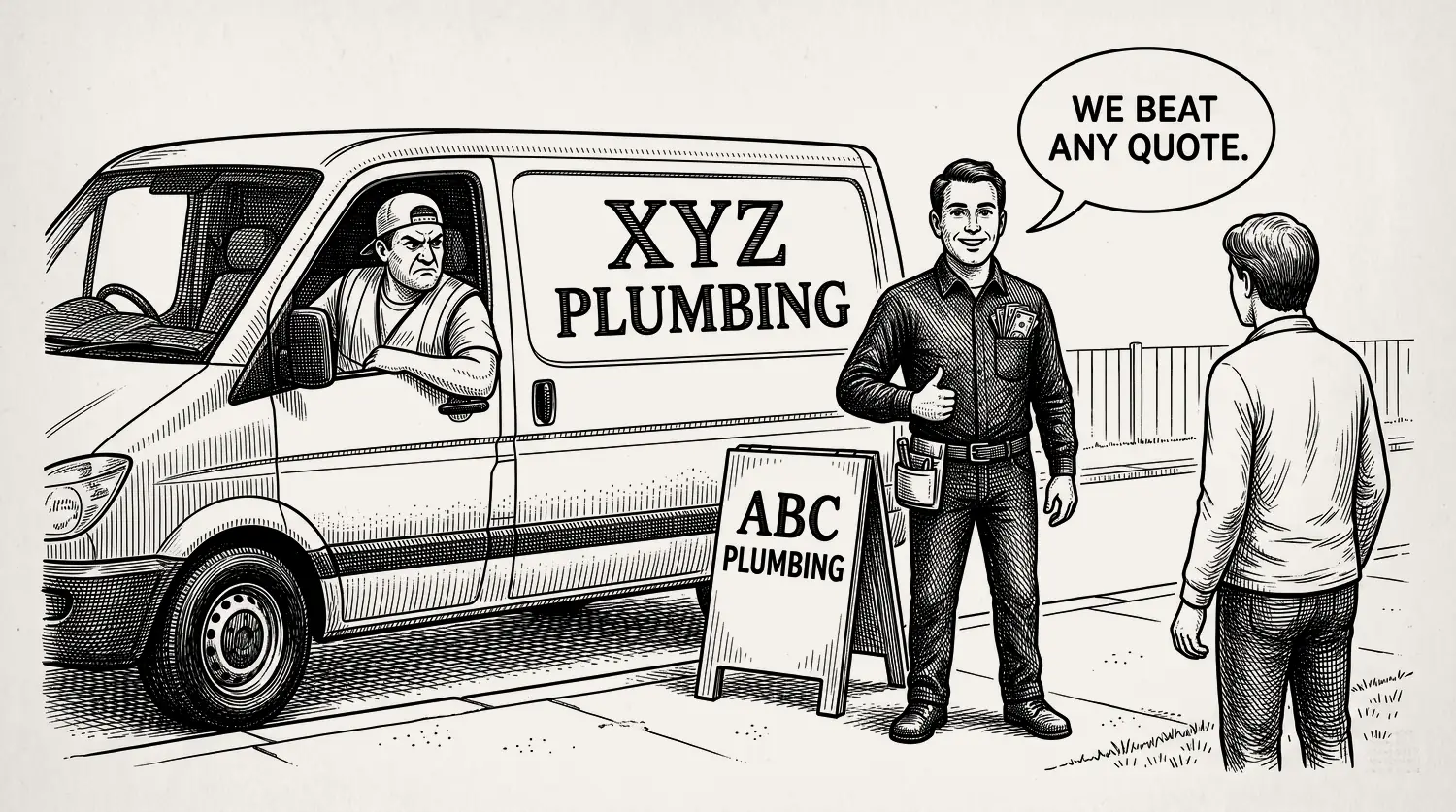
- Is it legal to bid on a competitor's name in Google Ads?
- What does a competitor campaign really cost?
- When does bidding on competitors pay, and when does it burn budget?
- How do you build a competitor campaign?
- What can you say in the ad?
- Where should the click land?
- How do you test it without wrecking the rest of the account?
- What happens when they bid back on you?
- FAQ
Is it legal to bid on a competitor’s name in Google Ads?
Yes. Google lets any advertiser use another business’s name as a keyword. There is no complaint that stops it, and no exclusive claim you can register over your own name as a search term. Your competitors can do it to you, and you can do it to them.
The line sits in the ad text, not the keyword. Google will investigate a complaint from a trademark owner about their trademarked name appearing in someone else’s ad copy. Use a rival’s trademarked name in your headline and expect the ad to be pulled.
So the rules are simple. Bid on the name. Do not write the name. Anything beyond that is a business decision, not a legal one, and the business decision is where most of the money is won or lost.
What does a competitor campaign really cost?
More than your normal keywords, and the reason is structural. Google prices clicks partly on relevance. Your ad and landing page cannot be relevant to another company’s name, so your ad relevance and landing page experience both come back below average. That is a low Quality Score, and a low Quality Score means you pay more for the same position.
Then the conversion rate works against you too. Someone searching a competitor by name has usually already picked. They saw the van, or a neighbour gave them the number. You are interrupting a decision, not entering an open race. Expect far fewer of those clicks to turn into calls than on a “roof replacement near me” search.
Put the two together and the picture is honest. Higher cost per click, lower conversion rate, so a much higher cost per lead than the rest of your account. Roofing already sits at a $228 median lead cost. A competitor lead in that trade can cost you a multiple of it, which is why we rarely open one until the rest of a roofing account is already tight. This is not a cheap tactic. It is an expensive one that sometimes works.
When does bidding on competitors pay, and when does it burn budget?
It pays when one won job is worth enough to cover a long run of wasted clicks. That is the only test. Take your average job value on the service, your margin, and your close rate, then work out what you can afford to spend to win one. If that number is big, you can absorb an expensive experiment. If it is small, you cannot.
| Your situation | The call |
|---|---|
| Whole-home window replacement, roof replacement, foundation repair, pipe relining, system replacement | Worth a controlled test. One job pays for months of clicks |
| A rival with a bad reputation and worse reviews than yours | Worth a test. You have something real to offer their searcher |
| You already outrank them on the actual service searches | Worth a test. You have covered the cheaper traffic first |
| Drain clears, tune-ups, small repairs, filter jobs | Skip it. The ticket cannot carry the click price |
| Your own name is not defended yet | Skip it. Fix that first, it is cheaper and it works |
| Your service campaigns are still limited by budget | Skip it. Buy the searches for the job before the searches for a name |
| The rival is a national franchise with a big budget | Usually skip it. You will pay for the privilege of losing |
The rule underneath the table: do this last, not first. Every dollar here is a dollar not spent on somebody actively looking for the job you do. If you have not filled your demand-capture campaigns yet, this is not your next move. See how to build one campaign per service.
How do you build a competitor campaign?
Seven steps. The important ones are the guard rails, because this is the campaign most likely to quietly drain money.
What can you say in the ad?
You cannot use their trademarked name. So sell the comparison without the name. Lead with the thing you do that they do not, and be specific enough that it means something. Vague is what everyone else writes.
Good lines for a home-services competitor ad look like this. “Same-day roof inspection, no contingency to sign.” “Licensed plumbers, no subcontractors.” “Free camera inspection before we quote.” “Financing on whole-home replacement.” Each names a real difference the searcher can check.
What does not work is a generic ad. If your ad says “quality service, free quotes”, it gives someone who already chose a company no reason to change their mind. You are asking them to abandon a decision they have made. That takes a concrete reason, in the first headline, in the space of about thirty characters. Ad copy examples has a bank of these.
Where should the click land?
On a page that answers “why not them”, not on your homepage. The searcher came in with a company in mind. If they land on a general homepage, they get no help comparing, and they go back to Google. That click is gone and you paid a premium for it.
Send them to your best proof page instead. Reviews, real job photos, your credentials, your warranty, and a phone number at the top of the screen. If you have a page for that exact service, use that one. This is the traffic where the page does most of the work, because the ad was not allowed to say much.
How do you test it without wrecking the rest of the account?
Set the rules before you switch it on. A hard budget cap, a review date, and one number that decides it. That number is booked jobs, not clicks and not leads. A competitor campaign will always produce some clicks. Clicks are not the question.
Here is the routine we run. Cap the spend at what you are willing to lose. Do not judge a keyword until it has roughly 50 clicks behind it, because before that you are reading noise. At the review date, count the booked jobs it produced and the money they made. If one job covers the test and then some, keep it and widen slowly. If not, turn it off and put the budget back on service searches. Turning something off on schedule is the hardest thing to do to your own idea, and it is one of the plainer reasons owners hand the account to someone paid to be strict with it.
Then check the search terms weekly while it runs, because a competitor’s name often matches searches that have nothing to do with them. See the weekly search terms check. Be willing to kill it. Most of these tests fail, and the ones that work are usually on the biggest jobs.
What happens when they bid back on you?
Often, nothing. Plenty of contractors never notice. But assume they will notice, because the polite version of this tactic does not exist. Once you are on their name, you have invited them onto yours.
So defend first. Your brand campaign should already be running before you open this one. It is cheap, it holds the top spot on your own name, and it is the thing that makes a retaliation harmless. See brand campaigns.
Then watch who shows up. The Auction Insights report shows which domains keep appearing in your auctions, which tells you if the fight is real or just one ad you saw once. See who keeps turning up in your auctions. If a rival starts using your trademarked name in their ad text, file a trademark complaint with Google rather than raising your bids. And if they start clicking your ads instead of bidding on them, that is a different problem with a different fix. See click fraud.
Stop reading · start fixingSee where your pipeline is leaking.Free 15-minute Leak Finder. We pull up your numbers, name your biggest leak, and hand you a 90-day plan. No sales script, no hard close.Find My Google Ads LeaksFAQ
Is bidding on competitor keywords against Google’s rules? No. Google allows any advertiser to bid on another business’s name as a keyword, and there is no way to block it. The restriction is on ad text. If you use a competitor’s trademarked name in your headline or description, the trademark owner can complain and Google will investigate.
Why is my Quality Score so low on competitor keywords? Because your ad and landing page cannot be relevant to somebody else’s business name. Ad relevance and landing page experience both come back below average, and there is no fix. Accept the low score on this campaign and keep it out of your service campaigns, where relevance is worth real money. See Quality Score.
How much should I spend testing a competitor campaign? An amount you have already decided to lose. Set a hard cap and a review date before you start. Judge it on booked jobs and what those jobs earned, not on clicks or leads. If one job does not cover the test on a high-ticket service, the test has answered you.
Should I bid on a big national franchise’s name? Usually not. They have the budget to hold their own name and the brand recognition to make your ad look like a substitute nobody asked for. Pick local rivals you genuinely lose jobs to, where the searcher is choosing between two similar businesses rather than reaching for a name they already trust.
Can I stop a competitor bidding on my business name? No, and you should stop trying. The lever you do have is your own brand campaign, which holds the top spot on your name cheaply, plus a trademark complaint if your name shows up in their ad text. See brand campaigns.


