- What is the best Google Ads account structure for a contractor?
- What are the levels of a Google Ads account?
- How should a home-services account be organised?
- Should you separate brand and non-brand campaigns?
- Are single keyword ad groups (SKAGs) still worth it?
- How does account structure affect Quality Score and cost?
- How structure feeds Smart Bidding
- FAQ
What is the best Google Ads account structure for a contractor?
The best structure for a contractor is the simple one. Split your campaigns by service line, by the areas you serve, and by brand versus non-brand. Give each campaign a few tight ad groups grouped by theme. Keep keywords close and ads relevant. A small account does not need dozens of campaigns. It needs clean, honest splits the bid strategy can read.
Most contractors get this backwards. They build one campaign called “our services” and dump every keyword in. Google then gets no signal about which clicks book jobs. Or they build sixty tiny campaigns and split the data so thin that Smart Bidding never learns. Both are the same mistake in different clothes.
Aim for the middle. Enough campaigns to separate things that behave differently. Few enough that each one gathers real data.
What are the levels of a Google Ads account?
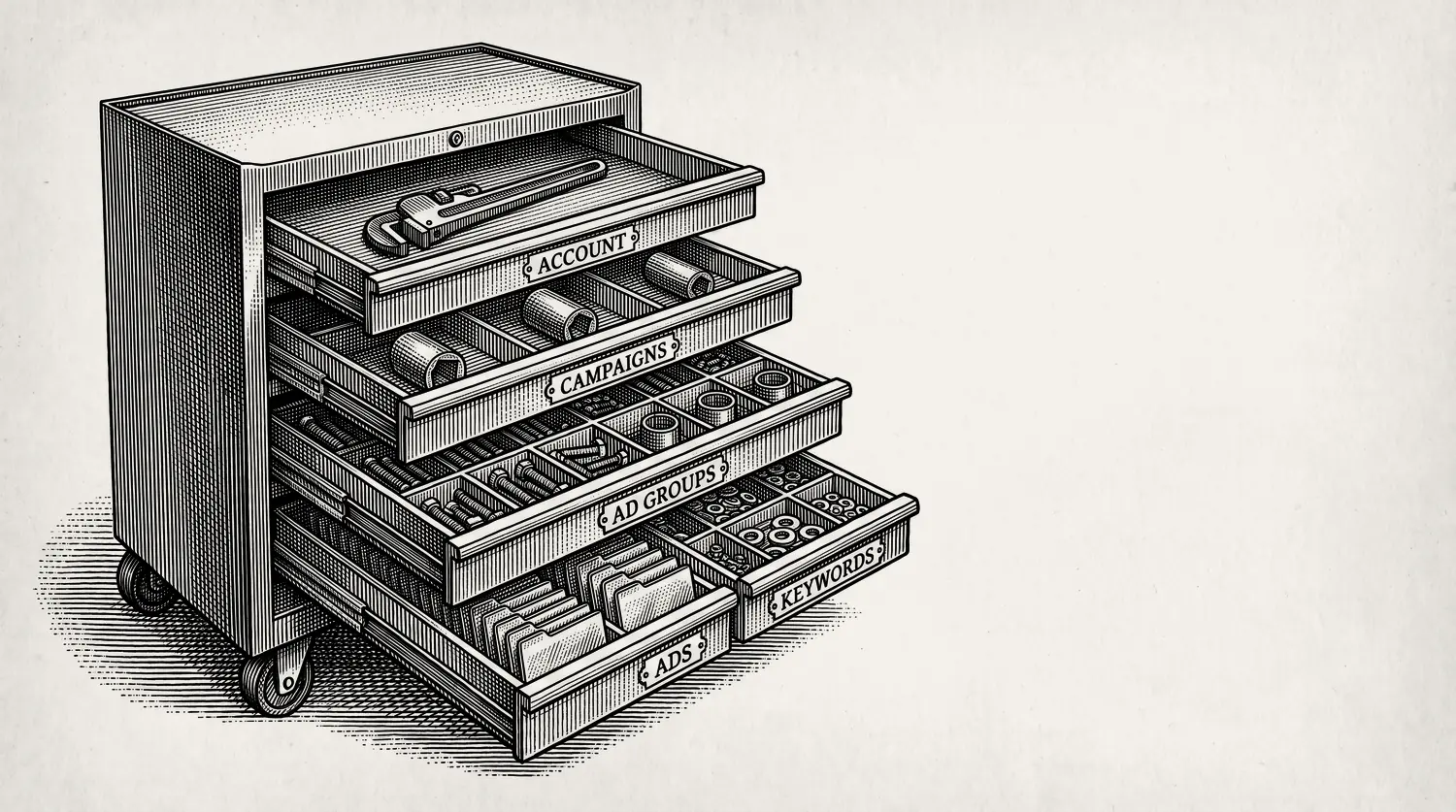
A Google Ads account has five levels, nested inside each other. The account holds campaigns. Campaigns hold ad groups. Ad groups hold keywords and ads. Settings like budget, location, and bidding live at the campaign level. Keywords and ad copy live further down. Knowing which lever sits at which level is most of what “structure” means.
| Level | What it is | What you set here |
|---|---|---|
| Account | The whole thing | Billing, time zone, currency |
| Campaign | A group with its own budget | Budget, location, schedule, bid strategy |
| Ad group | A theme inside a campaign | The theme, the shared landing page focus |
| Keyword | A search you want to show for | Match type, negatives |
| Ad | What the searcher sees | Headlines, descriptions, assets |
Read that top to bottom and the rules fall out. Want a separate budget for emergency work? That is a campaign. Want a different set of keywords under the same budget? That is an ad group. You do not open a new campaign just to add a keyword.
How should a home-services account be organised?
Organise the account the way you run the business. One campaign per service line, so each has its own budget and bids. One split by service area if you serve very different regions. One brand campaign for your own name. Inside each service-line campaign, a couple of tight ad groups by theme, plus a way to catch the searches your keywords miss.
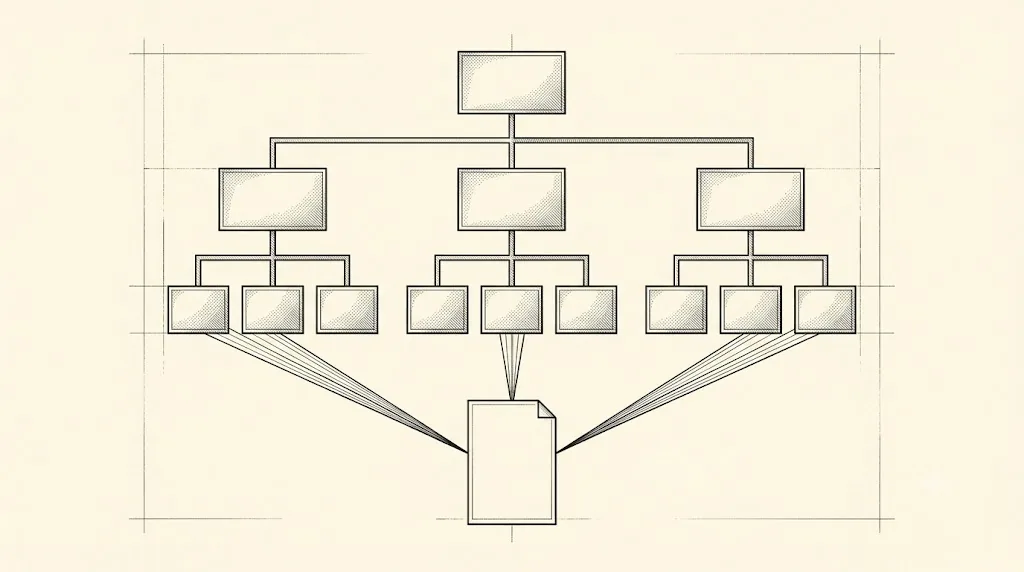
Here is the shape we build. It is the same skeleton for air conditioning installs, drain clearing, or roof replacement.
- Brand campaign. Your own company name. Bids to hold the top spot on Target Impression Share (you tell Google to aim for a share of the top of the page). Cheap clicks, and it stops competitors sitting on your name.
- Service-line campaigns, one per job type. Emergency work in one. Installs and quotes in another. Split them this way because they run on different hours and often different crews. Your after-hours emergency money should not quietly get spent on window quotes at two in the afternoon. Each runs Target CPA (you set a target cost per lead and Google bids to hit it), pointed at the real conversion, a call or a form. Where to draw the line between one service and the next is the whole of our guide to running one campaign per service.
- A campaign for your best jobs, the ones with the fattest margin, so you can bid those harder without dragging the rest up with them. For a foundation business that is underpinning, not a crack inspection.
Inside each service-line campaign, use two kinds of keyword. Exact match for your best-known terms, like [emergency plumber]. And a broad or phrase group for the same theme, to catch searches you would never think to add. Give every ad group at least one strong responsive search ad. Google scores each one with Ad Strength, from “Poor” to “Excellent”. Treat that score as a writing guide, not a ranking factor. Google puts it plainly: Ad Strength “isn’t used to calculate Ad Rank, Quality Score, or auction wins”, and it does not directly affect whether your ad is eligible to show.[2] Write the best ad you can, then stop chasing the meter.
Add one more layer that finds money the keyword list forgot. This used to be a Dynamic Search Ads ad group. Do not build one now. Google is retiring Dynamic Search Ads and replacing it with AI Max, a setting you switch on inside a normal Search campaign. From September 2026 you cannot create new campaigns with Dynamic Search Ads at all, and from February 2027 the ones still running are upgraded to AI Max on their own.[3] So do not build a new account around Dynamic Search Ads today. You would only be building something Google is about to move for you.
AI Max does the same job in a new way. Switch it on in the campaign’s settings and Google reads your website and your existing ads, then matches searches your keywords never covered. The part that replaces the old dynamic ad group is called final URL expansion, which sends each search to the page on your site that fits it best. Your keywords keep working alongside it.
Turn it on with the guard rails set, not wide open. Google gives you three real controls, and a contractor should use all three. Brand exclusions stop you paying for other companies’ names. URL exclusions stop it sending traffic to your careers or about page. Text guidelines tell it how you are allowed to talk. Your negative keywords still apply too, and that matters more than the rest put together. Start it in one service-line campaign, watch the search terms report for a fortnight, and only widen it once you can see what it is buying.
Keep the account tidy as it grows. Two habits do most of it.
First, stop your own campaigns bidding against each other. If the same search can trigger two of your campaigns, Google picks one and you pay a higher price for the privilege. The fix is simple. When a keyword lives in one campaign, add it as a negative keyword in the campaigns that should not have it. Ten minutes when you add a new service line saves you paying twice for the same job.
Second, when you add audiences, like people who visited your site before, set them to observation rather than targeting. On observation, Google still shows your ads to everyone and just tells you how that group did. On targeting, only that group sees your ads at all. On day one you want the information, not the smaller audience. You can always switch later, once you can see who books.
Should you separate brand and non-brand campaigns?
Yes. Always keep your brand campaign separate from everything else. Someone searching your company name already knows you, probably from a neighbour or a van they saw. Those leads are cheap and they book often. Someone searching “emergency plumber” has never heard of you. They cost more and book less. Mix the two in one campaign and the cheap, easy jobs from your own name hide how badly you are doing at winning new customers.
This is the single easiest thing to check on a report someone sends you. If you see one cost per lead for the whole account, ask what it looks like with brand taken out. The gap is usually large. That second number is the one that tells you whether the ads are actually growing the business. Anyone running the account for you should report it that way, and showing what the ads win that your own name would not is how we do it.
Separate campaigns also let you bid them differently. Brand can chase the top spot on Target Impression Share, because those clicks are cheap and yours to lose. Non-brand runs on Target CPA, judged on cost per booked job. You cannot run both stances in one campaign.
There is a defensive reason too. Competitors can bid on your name. A cheap brand campaign keeps you sitting above them on your own turf. How to build one, and what to do when a rival turns up on your name, is in our guide to holding the top spot on your own name. Going the other way and bidding on theirs is a separate campaign with its own maths.
Are single keyword ad groups (SKAGs) still worth it?
Mostly no. Single keyword ad groups, or SKAGs, put one keyword in its own ad group for total control. That made sense years ago, when match types were literal and you could micromanage every search. It does not fit today. Match types now catch close variants you cannot fully control, so a one-keyword group just fractures your data.
Use tight themed ad groups instead. Group a handful of keywords that mean the same thing to a customer and can share one ad and one page. “Emergency drain” terms together. “Hot water repair” terms together. “Basement waterproofing” terms together. That gives the ad enough traffic to prove itself and gives Smart Bidding enough booked jobs to learn from.
The old goal behind SKAGs, keeping the keyword, the ad, and the page all about the same job, is still right. You just reach it now with themed groups, not hundreds of tiny ones. See keyword match types for how the matching actually behaves.
How does account structure affect Quality Score and cost?
Structure drives Quality Score, and Quality Score drives what you pay. When a keyword, its ad, and its landing page all match, Google rates the ad higher. A higher rated ad wins better positions for a lower cost per click. Tight ad groups make that match easy. A messy catch-all campaign makes it impossible, so you overpay on every click.
Quality Score (Google’s 1-to-10 rating of how relevant and useful your ad is) rewards relevance. Themed ad groups, matched ads, and matched pages are how you earn it. See our Quality Score guide for the full picture.
The money follows. A dear click gets dearer when your structure is loose. On roofing, where the median cost per click is $10.70, a poor Quality Score can add real dollars to every single click. Tightening that structure is the first job in a roofing account paying over the odds for every click. For what a lead should cost you by trade, see the cost guide.
How structure feeds Smart Bidding
Smart Bidding runs on conversion data. Clean structure gives it clean data. When your conversions are set up right and your campaigns are split by things that truly behave differently, the algorithm sees clear patterns and bids well. When everything is jammed into one bucket, or your conversions count junk calls, it optimizes toward noise. Structure is how you feed the machine.
Google says it plainly. Smart Bidding uses Google AI to bid for conversions in every auction, and to use it you need conversion tracking enabled.[4] So the whole thing rests on tracking that tells a booked job from a wrong number. Set that up first. See conversion tracking.
There is a balance in the splitting. Split too little and different jobs share one bid target that fits none of them. Split too much and each campaign gets so few conversions that the algorithm never settles. Enough conversions in a campaign is what steadies the bidding. That trade-off is covered in our Smart Bidding guide.
Stop reading · start fixingSee where your pipeline is leaking.Free 15-minute Leak Finder. We pull up your numbers, name your biggest leak, and hand you a 90-day plan. No sales script, no hard close.Find My Google Ads LeaksFAQ
How many campaigns should I have? As few as cleanly separate the things that behave differently. A small contractor might run three to five. One brand, two or three service lines, maybe one high-intent. Do not open a campaign for every keyword. Each campaign needs enough conversions to let the bidding learn.
How many keywords per ad group? A handful that share one intent, not one and not fifty. Enough that the ad group gets steady traffic, few enough that a single ad and landing page fit them all. Tight themed groups beat both single-keyword groups and giant grab-bags.
How many ad groups per campaign? A few, split by theme. Two to five is common for a service-line campaign. Each ad group should map to a search intent with its own ad and page focus.
Do I need a manager (MCC) account? Not for a single business. A manager account, sometimes called an MCC, is for agencies and people running many accounts under one login. One contractor with one account does not need it.
- 1. LocaliQ, 3,211 US campaigns, April 2024 to March 2025
- 2. Google Ads Help, “About Ad Strength for responsive search ads” ↩
- 3. Google Ads Help, “About Dynamic Search Ads”; Google blog, “Google’s Dynamic Search Ads are upgrading to AI Max” ↩
- 4. Google Ads Help, “About Smart Bidding” ↩
- 5. SearchLight, January 2026, 816 contractors, $14.9M spend


