
- What is Google Ads Quality Score?
- What are the three components of Quality Score?
- Where can I see my Quality Score?
- What is a good Quality Score?
- Why does Quality Score matter for expensive trade keywords?
- Quality Score vs Ad Rank: what's the difference?
- What causes a low Quality Score, and how do you fix it?
- How to fix the landing page experience
- Quality Score FAQ
What is Google Ads Quality Score?
Quality Score is Google’s rating of how relevant your keyword, ad, and landing page are to a searcher. It runs from 1 to 10 and sits at the keyword level in Search campaigns. Think of it as a report card. A 10 means Google sees your ad experience as excellent. A 3 means it sees a mismatch somewhere.
The number is there to find a problem, not to chase. It is not fed straight into the live auction, and nobody pays you for a good one. What it does is point you to the keywords where your ad and your page do not match the search well enough. On a local service account, that is worth real money, because a poor match means you overpay on every click, and that lands on your cost per booked job.
What are the three components of Quality Score?
Quality Score is built from three parts. Google shows each one as “Above average,” “Average,” or “Below average” next to the keyword. That wording tells you exactly where to look. A part marked “Below average” is the one dragging your score down, so that is where you start.
| Component | What it measures | How to move it |
|---|---|---|
| Expected click-through rate | How likely people are to click your ad when it shows for that keyword | Write ad copy that mirrors the search; tighten the keyword to the ad group |
| Ad relevance | How closely your ad text matches the keyword’s meaning | Put the keyword theme in the ad; split loosely-related keywords into their own ad group |
| Landing page experience | How useful and fast the page is for that search | Send the click to a page about that exact service, load fast, work on mobile |
The dashboard labels these “Exp. CTR” (expected click-through rate), “Ad relevance,” and “Landing page exp.” Read all three together. One weak part is usually the whole problem.
Where can I see my Quality Score?
Quality Score lives at the keyword level, and the column is switched off until you turn it on. In the Campaigns menu, open Keywords. Click the columns icon in the top right. Under “Modify columns for keywords,” open the Quality score section, tick Quality Score plus the three status columns (Exp. CTR, Ad relevance, and Landing page exp.), then click Apply.
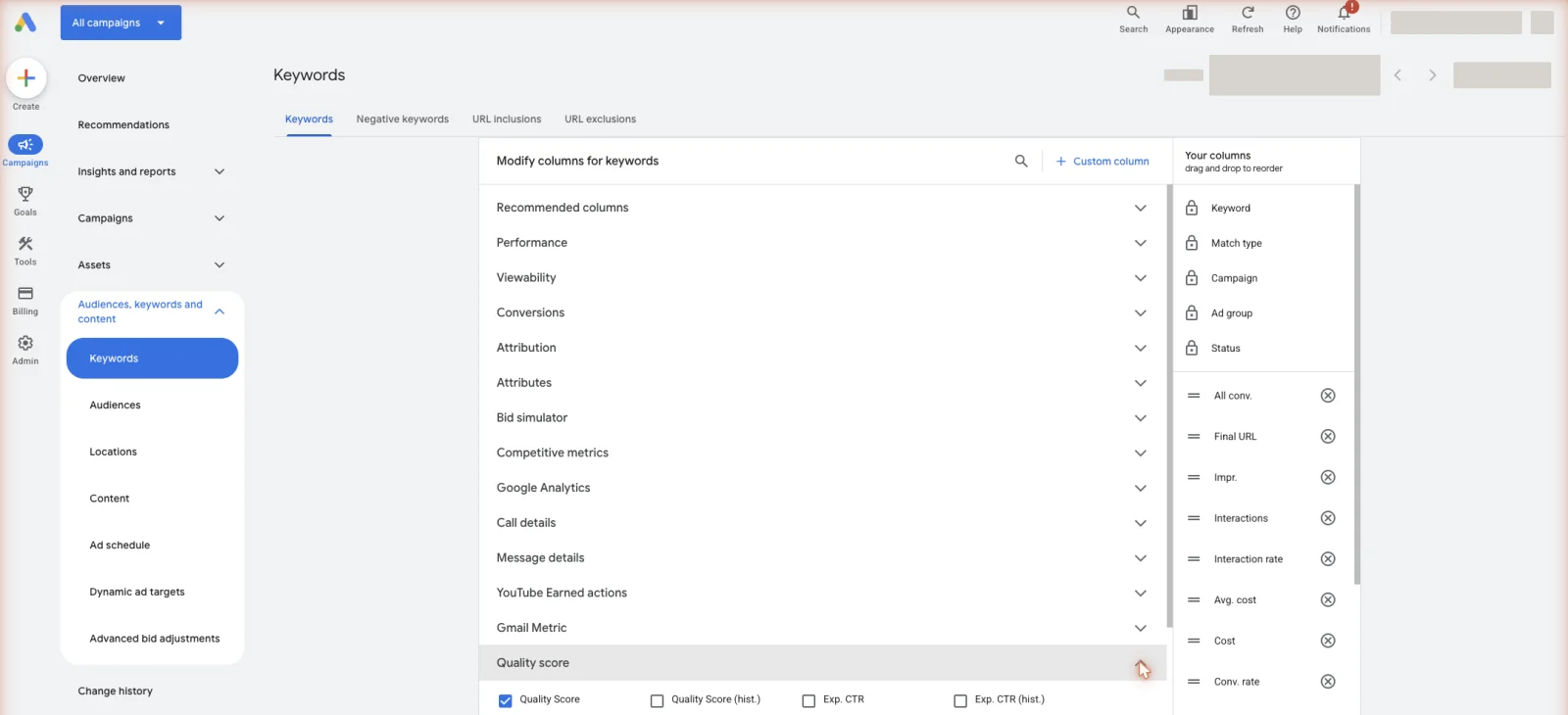
Now each keyword shows its 1 to 10 score and the three “above / average / below” labels beside it. The score alone tells you little. The three labels tell you what to fix. A keyword scoring 4 with “Below average” landing page experience is a page problem, not an ad problem.
Two catches. New accounts have this column hidden by default, so an empty Quality Score section usually means nobody switched it on, not that Google stopped reporting it. And brand-new keywords may show a dash or a “null” score until they gather enough data. That is normal. Give them clicks before you judge them.
What is a good Quality Score?
The common rule of thumb is that 7 or higher is healthy for a search keyword. Brand terms often run 9 or 10, and anything below 5 needs work. Treat that as an industry norm, not a Google promise. Google has never published a “good” number. The threshold is agency shorthand, and we use it the same way.
For a contractor, the score matters in cost-per-click terms, not as a grade to chase. A low score on a cheap keyword barely moves your budget. A low score on a $10 roofing click is expensive every single time it shows. So do not try to lift every keyword to 10. Find the low scores on your priciest terms and fix those first. That is where the money is.
One warning if someone else runs your account. A healthy average Quality Score in a monthly report means nothing on its own while your cost per booked job is climbing. Ask which of your expensive keywords score below 5, and what is being done about them. That is the useful version of the question, and a straight answer to it is a fair test of whether your Google Ads management is earning its fee.
Stop reading · start fixingSee where your pipeline is leaking.Free 15-minute Leak Finder. We pull up your numbers, name your biggest leak, and hand you a 90-day plan. No sales script, no hard close.Find My Google Ads LeaksWhy does Quality Score matter for expensive trade keywords?
A higher Quality Score can lower your cost per click and help your ad rank better without raising your bid. That saving is small in cents but large on trade keywords, because trade clicks are expensive. When a roofing click runs a $10.70 median, shaving a slice off every one of them adds up fast across a month of spend. That is why relevance is the first thing we work on when a roofing account is losing money on the click price alone.
That is the whole reason to care about the score. The payoff is largest where clicks cost the most. On a $1 keyword, relevance work saves you pennies. On a $10 to $50 emergency or roofing click, the same work protects real budget. And with plumbing and HVAC leads averaging $104, every bit of click cost you cut flows straight to a lower cost per booked job. Want the full picture of what a lead costs you? See the real numbers on Google Ads cost.
Quality Score vs Ad Rank: what’s the difference?
This is the most common mix-up, so here it is plainly. Ad Rank decides your position at auction time. It is worked out live, on each search. Google weighs your bid, the real-time quality of your ad and page, the context of the search, and your assets. Quality Score is the after-the-fact report card you read later. They are related but not the same.
The myth is that Quality Score is “the number used in the auction.” It is not. Google uses live quality signals in the auction, then reports Quality Score back to you as a 1 to 10 summary so you can diagnose. So do not bid based on the score. Use it to find weak keywords, fix the relevance, and let the live auction reward the work.
What causes a low Quality Score, and how do you fix it?
Low scores nearly always trace to one of a few causes. A keyword-to-ad mismatch, where the ad does not mention what the person searched. A weak or off-topic landing page. A low expected click-through rate, often from a dull ad. Over-broad keywords that pull in searches your ad was never written for. Or a messy ad group holding “window replacement”, “sliding door repair” and “double glazing cost” all at once, sharing a single ad that names none of them.
The fixes follow the cause. Split loose ad groups so each holds one tight theme. Rewrite the ad to name the service and the search intent. Give every ad group at least one strong responsive search ad, which is your main lever on ad relevance and expected click-through rate. And rein in over-broad keywords: tighter match types and a strong negative keyword list keep your ads on the searches they were built for.
How to fix the landing page experience
Landing page experience is where contractors lose the most points, because most send every click to the homepage. A homepage is a menu. A high-intent searcher does not want a menu. Someone who searched “emergency plumber” and lands on a general homepage has to hunt for the emergency page. Most will not. They bounce, and your score and your booked jobs both drop.
The fix is one page per service, matched to the search. The headline mirrors what they typed. The proof is for that job type. Someone who searched “basement waterproofing cost” wants a price range and photos of finished basements, not your full service menu. The page loads fast and works on a phone, because most emergency searches happen on mobile. And a tap-to-call button sits at the top of the screen, so the ready-to-book caller does not have to scroll. Match the page to the search and the landing page score climbs on its own. That match is the cheapest fix when basement waterproofing clicks are costing more than they should.
Quality Score FAQ
Does Quality Score affect cost per click? Yes, indirectly. A higher score reflects stronger live quality signals, and those can earn you a lower cost per click and a better position for the same bid. The exact saving varies by auction, so do not trust a fixed percentage. The direction is reliable: more relevant ads tend to cost less per click.
How often does Quality Score update? It updates as your keywords gather fresh data, so it can move day to day. After you change an ad or a landing page, give it time and clicks before you check whether the score moved. A change with no traffic behind it will not show up right away.
Can I see Quality Score for Performance Max? No. Quality Score is a Search-keyword diagnostic. Performance Max does not run on keywords, so it has no Quality Score to show. Judge Performance Max on conversions and cost per lead instead. The Performance Max guide covers what to watch there.
Should I try to get every keyword to 10? No. Chasing a perfect score wastes time on cheap keywords that barely move your budget. Focus on low scores on your expensive trade keywords, where a lower cost per click actually protects real money. Leave the healthy scores alone.
Does Ad Strength affect Quality Score? No, and this one trips up a lot of people. Ad Strength is the meter beside your responsive search ad that rates how varied your headlines and descriptions are. Google is blunt about its limits: it “isn’t used to calculate Ad Rank, Quality Score, or auction wins,” and the rating “doesn’t directly influence your ad’s serving eligibility”.[2] Quality Score is the separate 1 to 10 keyword diagnostic this page is about. Write better ads because better ads win clicks and book jobs. Do not write them to move a meter that never reaches the auction.


