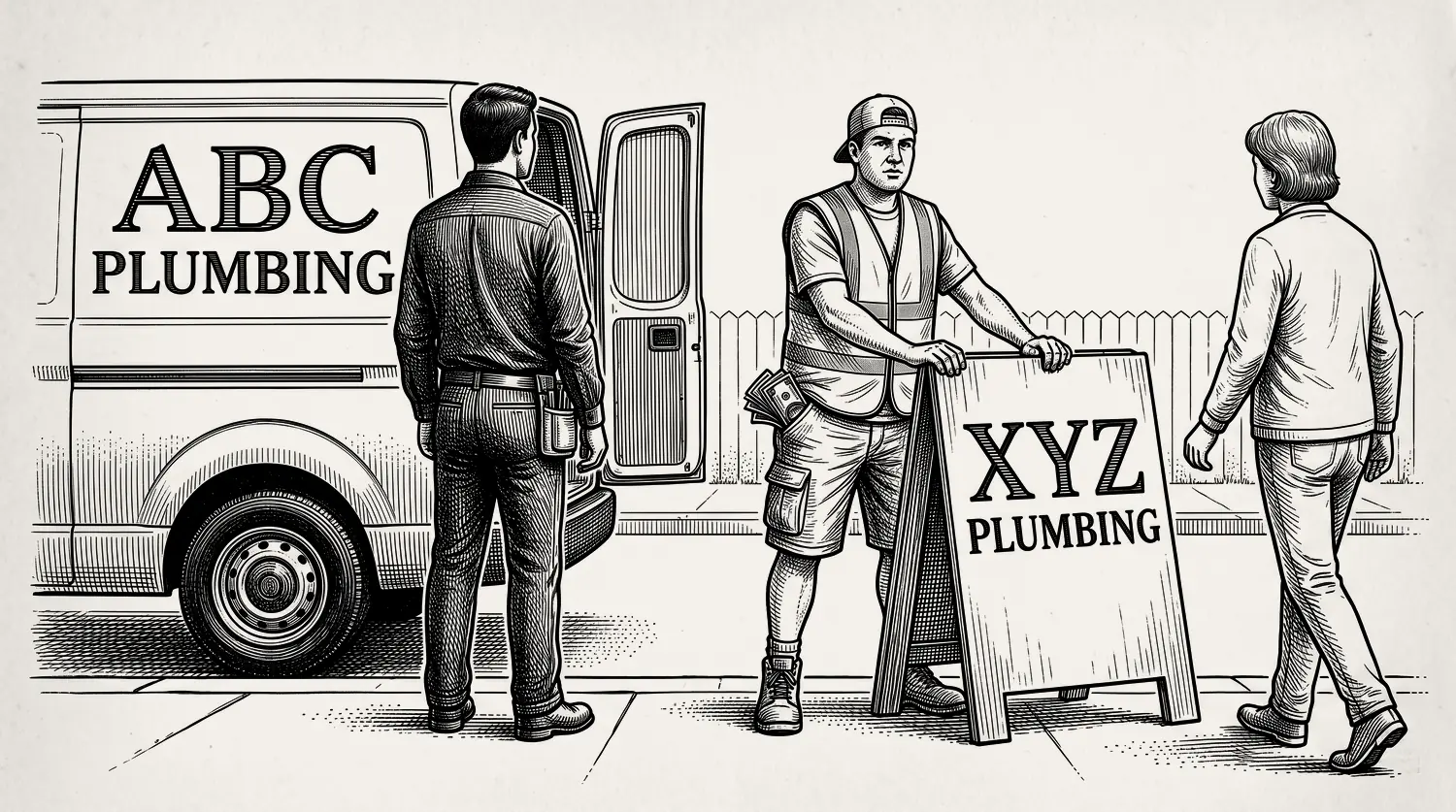
- What is a brand campaign in Google Ads?
- Why are brand clicks so cheap?
- Should you bid on your own name?
- How do you build a brand campaign?
- What should the ad above your own name say?
- What do you do when a competitor bids on your name?
- When is a brand campaign not worth it?
- How do you tell whether it is paying for itself?
- FAQ
What is a brand campaign in Google Ads?
A brand campaign is a Search campaign that bids only on your own business name and its close variants. When someone types your company name, your ad shows above the organic results. You choose the headline, the offer, and the page they land on. It is the smallest campaign in most accounts and one of the cheapest.
Google sells your name like any other keyword. There is no ownership rule that keeps other advertisers off it. So the question is not whether your name is for sale. It is whether you are the one buying it.
Keep it in its own campaign, always. Brand searches convert cheap and often, so mixing them with your service keywords hides how your real prospecting is doing. The full skeleton is in our account structure guide.
Why are brand clicks so cheap?
Because relevance is what Google charges you on, and nothing is more relevant to your name than you. Your keyword, your ad, and your page all say the same thing. That earns a high Quality Score, and a high Quality Score buys a better position for less money. Most brand keywords sit at the top of the 1 to 10 range.
Compare that with what you pay to get found cold. In roofing the median click costs $10.70. A brand click on the same account usually costs a small share of that, because you are not fighting five other roofers for the search. You are just standing on your own name.
There is a second reason, and it is the important one. The person searching your name has already been sold. They saw the truck, or a neighbour told them, or they read your reviews last night. They are not shopping any more. They are looking for your phone number. That is why the cheap click is also the one most likely to book. Quality Score and how it moves your click price is covered in our Quality Score guide.
Should you bid on your own name?
Sometimes. The deciding question is whether anyone else is showing up on your name. If a rival’s ad sits above your organic listing, run a brand campaign and take the spot back. If your search results are yours alone and your listing sits solidly first, that money books more jobs on service searches instead.
Search your own business name on your phone, off your office WiFi, and look at what is above your listing. Then use the table.
| What you see when you search your name | The call |
|---|---|
| A competitor’s ad sitting above your listing | Run it. You are paying for that lead twice if you do not |
| Your organic listing moves around or sits below the fold | Run it. The ad puts you back above the fold |
| Your name is easy to confuse with another local firm | Run it. Confusion sends your customers to them |
| Nothing but your own listing, locked at the top, no ads | Skip it for now. Recheck each quarter |
| Budget too tight to keep your service campaigns fed | Skip it. Feed demand first |
The mistake is running one on autopilot because everyone says to. The other mistake is refusing to run one while a competitor quietly eats the warmest traffic you have.
How do you build a brand campaign?
Six steps, and the whole build takes about twenty minutes. Keep it small and separate. This is a defensive campaign, not a growth one, so it does not need scale.
What should the ad above your own name say?
Use it to say what your organic listing cannot. Your listing shows a title tag and a description Google may rewrite. Your ad shows your booking promise, your current offer, sitelinks to the exact service pages, and a call button. You control every word of it.
So do not waste the space repeating your company name back to someone who just typed it. They know who you are. Tell them the thing that gets them to call now. Same-day service. Answer the phone 24 hours. Free camera inspection on a blocked drain. Financing on a full system.
Then send the click somewhere better than the homepage. A homepage is a menu, and a menu makes a ready customer hunt. Send brand traffic to the page that books, with the phone number at the top of the screen. Ad copy examples has lines you can lift.
What do you do when a competitor bids on your name?
First confirm it. Search your name, and check the Auction Insights report on your search campaigns to see which domains keep showing up beside you. That tells you whether the threat is real or a story you heard. See our guide to reading the auction insights report.
Then defend. Run your brand campaign and hold the top spot. The economics are on your side. Your ad is far more relevant to your name than theirs is, so you can usually hold that position for less than they are paying to challenge it. They are buying an expensive click from a person who was not looking for them.
There is one more lever. Bidding on your business name as a keyword is allowed. Using your trademarked name inside their ad text usually is not. If your name is trademarked and it appears in a rival’s headline, file a trademark complaint with Google. That gets the text changed without a bidding war.
What we would not do is retaliate on reflex. Bidding on their name back is a separate decision with its own maths, and it is usually a worse deal than defending your own. Read how to build a competitor campaign before you spend a dollar there. If the problem is a rival clicking your ads rather than bidding on your name, that is a different fix, covered in click fraud.
When is a brand campaign not worth it?
When nobody is competing for your name and you already hold a stable top organic spot. Then the paid click may be buying a visitor you were getting free. That is the honest case against, and plenty of contractors are in it. Say no and spend the money where new customers are.
Three more times to skip it. When your business name is unusual enough that no rival can target it without looking silly. When your budget is so tight that your service campaigns are already starved, because defending a name nobody is attacking will not fill next week. And when your name is a common phrase, like “City Plumbing”, where a brand campaign will pull in searches that were never about you.
Recheck every quarter. The answer changes the day a competitor with a new agency decides to get clever. If nobody is checking on your behalf, put it in the diary, because watching who turns up on your name is part of running an account, not a one-off job.
How do you tell whether it is paying for itself?
Watch what your free clicks do when the paid ad runs. A brand campaign always looks brilliant on paper, because the people were already sold. The real question is how many of those booked jobs you would have won anyway through your organic listing. Jobs you would have got free are not new jobs.
Run a simple test. Note your organic clicks for two weeks with the brand campaign on. Pause it for two weeks and note them again. If your organic clicks jump by nearly the same number the paid campaign was booking, you were paying for traffic you already had. If organic barely moves while paid keeps booking, the campaign is winning searches you were losing.
Only run that test if no competitor is bidding on your name. If one is, pausing hands them a fortnight of your customers to find out something you already know. Judge it on booked jobs, not clicks, and keep the numbers separate from your non-brand campaigns. See the numbers that actually matter.
Stop reading · start fixingSee where your pipeline is leaking.Free 15-minute Leak Finder. We pull up your numbers, name your biggest leak, and hand you a 90-day plan. No sales script, no hard close.Find My Google Ads LeaksFAQ
How much should a brand campaign cost? A small share of the account. Your name has limited search volume, so there is a ceiling on what it can spend even if you let it. Set a low daily budget, check the spend after two weeks, and raise it only if you are losing impression share on your own name. It should never be the biggest line in the account.
What keywords should go in a brand campaign? Your business name, your name without the legal suffix, your name plus your main service, your name plus your city, and the misspellings people actually type. Use exact and phrase match. Add your owner’s name if customers search it. Check your search terms report after a fortnight and add what you missed.
Will a brand campaign cannibalise my organic clicks? It can, if no competitor is bidding on your name and you already rank first. Some people who would have clicked the free listing click the ad instead. That is why the pause test above matters. When a rival is bidding on you, the paid ad is holding a spot you were losing, which is defence, not cannibalisation.
Can I stop competitors bidding on my business name? Not the bidding itself. Google allows advertisers to bid on other businesses’ names as keywords, and there is no request that changes it. What you can stop is your trademarked name appearing in their ad text. File a trademark complaint with Google for that. Then outbid them where it counts, on relevance.
Should a brand campaign use broad match? No. Keep it on exact and phrase. Broad match on a brand campaign pulls in searches that have nothing to do with you and quietly turns your cheapest campaign into a general one. Do not switch on the campaign-level broad match setting either. See match types.


