- What is a service campaign in Google Ads?
- Why does each service need its own campaign?
- Which of your services deserve their own campaign?
- When is a service an ad group, not a campaign?
- How do you build a service campaign?
- Should emergency and planned work be split?
- What target should each service campaign carry?
- What breaks when one campaign holds every service?
- Regional notes: UK and AU
- FAQ
What is a service campaign in Google Ads?
A service campaign is a campaign built around a single service line. One campaign for emergency drain clearing. Another for pipe relining. Another for hot water. Each holds only the keywords for that job, its own budget, its own bid target, and ads that talk about that job and nothing else.
It matters because budget, location, schedule, and bid strategy are all campaign-level settings. If two services share a campaign, they share every one of those. You cannot pay more for the job worth ten times as much, because there is only one target for both.
The levels and what sits at each one are in our account structure guide. This page is about the split itself.
Why does each service need its own campaign?
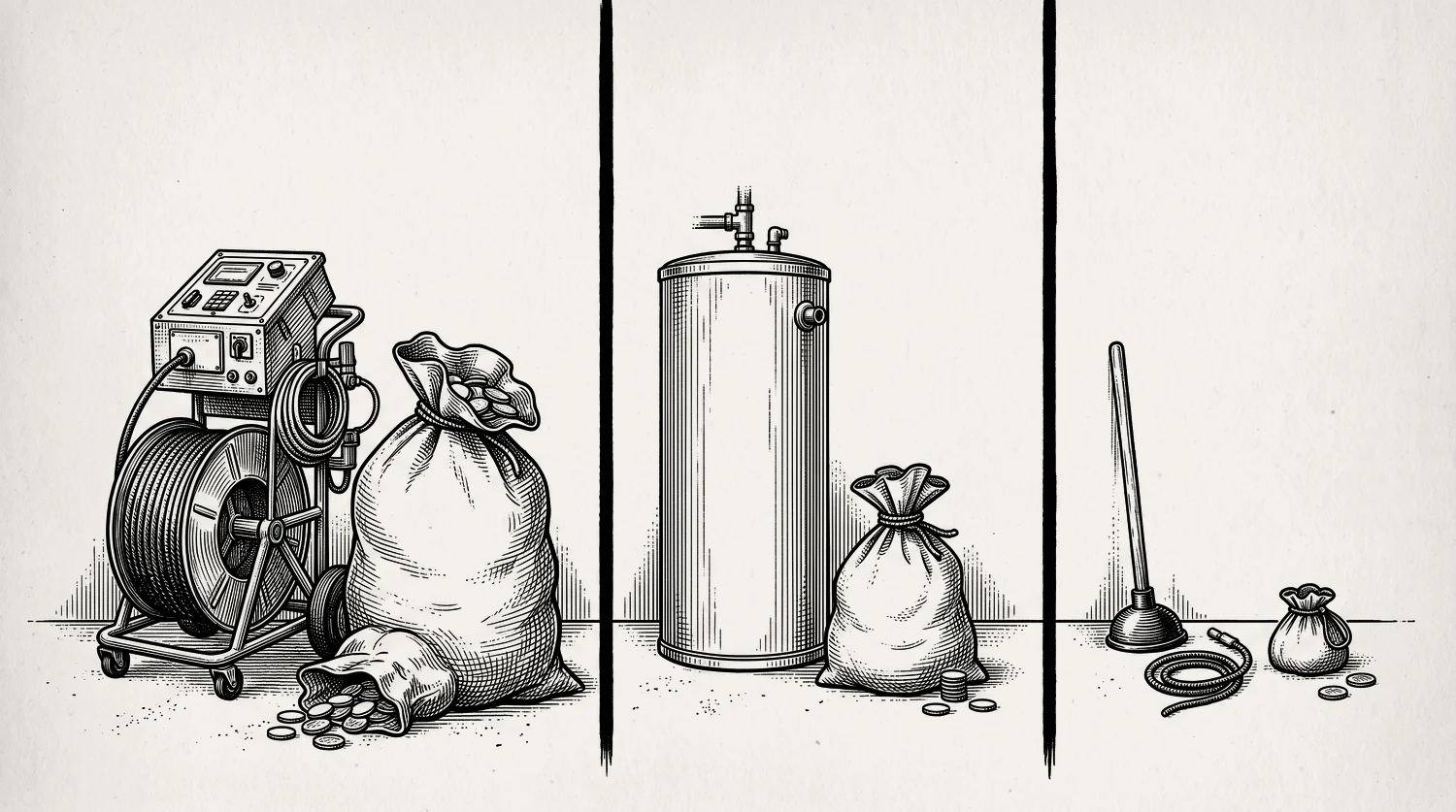
Because money moves at the service level, not the business level. Your average ticket, your close rate, and what a click costs all change from job to job. One campaign holding all of them gives Google one target for jobs that deserve different targets. The result is predictable. Your cheap, high-volume service eats the budget and your profitable one starves.
Watch how it happens. Say drain clearing books at a few hundred dollars and pipe relining books at five figures. Both sit in one campaign with one budget. Drain searches are far more common, so they win most of the auctions and spend most of the money. Your reporting looks fine, because leads are flowing. Meanwhile the relining work, the job that actually pays for the truck, gets whatever is left.
Split them and each service gets a budget you control, a target you set, and an ad that speaks to that customer. You also get honest numbers. You can finally see what a relining lead costs versus a drain lead, instead of one blended figure that describes neither. Blended is how a $104 average hides a service losing money. Keeping the relining budget safe from the drain work is most of what a pipe relining campaign is there to do.
Which of your services deserve their own campaign?
Split the services with real job value, a distinct buyer, and enough searches to stand alone. Keep the small stuff grouped. Here is where the line usually falls in each of the six trades we work in. Use it as a starting point, not gospel, because your mix is your own. This split is the first thing we rebuild when a home-services account is not paying for itself, because everything downstream inherits it.
| Trade | Own campaign | Ad group inside another campaign |
|---|---|---|
| Plumbing | Emergency drain clearing, pipe relining and trenchless work, hot water replacement, repipes | Tap and toilet repairs, leak detection, small callouts |
| Roofing | Roof replacement, storm and insurance work, commercial roofing | Roof repairs, gutter work, inspections |
| Foundation and basement | Foundation repair and piering, basement waterproofing, crawl space encapsulation | Wall anchors, egress windows, sump pump swaps |
| Windows and doors | Whole-home replacement, entry and patio doors | Single window replacement, failed unit swaps, screens |
| Restoration | Water damage and emergency mitigation, mould, fire | Contents cleaning, board-up, small make-safe jobs |
| HVAC | Air conditioning replacement, furnace or heat pump replacement, emergency repair | Maintenance plans, tune-ups, duct cleaning, filter jobs |
Read the pattern down the column. Replacement and emergency work gets its own campaign. Small repairs ride along as ad groups. The exception is any service you are actively trying to grow, like crawl space encapsulation or relining. Give that one its own campaign even if it is small, because that is the only way to protect its budget from the bread-and-butter work.
When is a service an ad group, not a campaign?
When it cannot feed a campaign on its own. Smart Bidding learns from conversions, and a campaign with two leads a month never gathers enough to learn anything. Split too far and you end up with six campaigns that are all guessing. That costs you more than the blending you were trying to fix.
Keep it as an ad group when any of these is true.
- Too few searches. If the service gets a handful of searches a month in your area, it will not sustain its own campaign. Group it with the nearest related service.
- Too little budget. Every campaign needs enough daily budget to compete. Splitting $40 a day across five campaigns gives each of them $8, and $8 buys almost nothing on a trade click.
- Same money, same buyer. If two services have similar job values, similar close rates, and the same kind of customer, they can share a campaign and just have separate ad groups.
- You are still in your first 90 days. Start simple. Two or three campaigns, then split once you can see which searches actually book. See the first 90 days.
There is a real cost to over-splitting, and it shows up in the bidding. If a campaign on Target CPA shows the “Limited by budget” status, it heads toward the target you set rather than beating it. Five starved campaigns all sit in that state at once. See Smart Bidding.
How do you build a service campaign?
Same seven steps for every service. Once you have built one, the rest are copies with different words.
Two or three tight ad groups inside each campaign is plenty. One per search intent, sharing one ad and one page.
Should emergency and planned work be split?
Yes, and it is usually the first split worth making. An emergency search and a planned-work search are two different customers with two different clocks. The emergency caller wants someone now and will pay for now. The person pricing a replacement is gathering quotes and may take three weeks to decide.
Those two need different everything. Different ads, because “we can be there today” is wasted on a planner. Different schedules, because emergency work runs after hours and planned work does not. Different targets, because an emergency job closes on the phone and a replacement quote closes at the kitchen table. Different pages too.
You cannot run both stances in one campaign, because the schedule and the bid strategy are campaign-level settings. So split them. Water damage callouts away from rebuild work. Burst pipes away from repipes. Breakdown repair away from system replacement.
What target should each service campaign carry?
Work it back from the job, not from what feels expensive. Take the job’s value and your margin on it. That gives you what you can afford to spend to win one. Then divide by your close rate on that service, because not every lead books. What is left is the cost per lead that service can carry.
Say a service books at a $12,000 average with a 40% margin, and you close one lead in four. You can afford roughly $4,800 to win a job, so a lead can cost you a lot before that job stops paying. Now run the same maths on a small repair with a $400 ticket. The affordable lead cost is a few dollars. Same account, targets an order of magnitude apart. That is the whole argument for splitting.
This is why a $228 roofing lead is not expensive and a $40 lead can be. The lead cost only means something next to the job it produces. The full method, including how to turn cost per lead into cost per booked job, is in the numbers a service business needs.
What breaks when one campaign holds every service?
Four things, and they compound. Your cheapest service takes the budget, because it has the most searches and the lowest click price. Your ads get generic, because one ad has to cover six jobs. Your bidding gets confused, because Google is optimising toward one target for jobs worth wildly different amounts. And your reporting stops telling you anything, because everything arrives as one blended number.
The tell is easy to spot. Open your search terms report and look at where the money went last month by service. If 80% of the spend is on your smallest job type, the campaign is not broken, it is doing exactly what you built it to do.
The fix is not more keywords. It is the split, one campaign per service line, each with a budget and a target it can defend.
Regional notes: UK and AU
Your campaign names and keywords have to use the words your customers type, and those words change by country. The service is the same. The search is not.
- Trenchless plumbing. Pipe relining in Australia and New Zealand. Drain lining or no-dig in the UK. Sewer lining or trenchless sewer repair in the US. Build the campaign in the local term, or you will bid on words nobody searches.
- Foundation work. Foundation repair and piering in the US. Underpinning in the UK, Australia and New Zealand. In Victoria, restumping and reblocking are their own campaigns. UK subsidence work is an insurance search, which makes it a different buyer to a US settlement job, not just a different word.
- Windows. Replacement windows in the US. Double glazing in the UK, Australia and New Zealand, where retrofit double glazing is its own campaign in New Zealand.
- Restoration. Water mitigation in the US. Damage management or escape of water in the UK, where homeowners search “damp and mould”. Make-safe in Australia and New Zealand. Basements are a US and UK search, so a flooded basement campaign has no audience in Australia.
FAQ
How many campaigns should a contractor run? As few as cleanly separate the things that behave differently. Most small crews land on three to five. One brand campaign, two or three service campaigns, and sometimes one for the highest-margin work. Add campaigns when a service earns one, not on a schedule.
Should I split by service or by location? Service first, almost always. Your services have different job values and different targets, which is what campaign settings control. Split by location only when your areas genuinely differ, like two metros with different competition or different pricing. See location targeting.
Can I just use ad groups instead of separate campaigns? Only if the services share a budget and a target comfortably. Ad groups control keywords, ads, and landing pages. They do not control budget, schedule, or bid strategy. If two services need different money, they need different campaigns.
What if a service does not get enough searches for its own campaign? Keep it as an ad group inside the closest related campaign and watch its search terms. When it starts producing steady leads, and you can fund it daily without starving the rest, pull it out into its own campaign. Splitting too early gives Smart Bidding nothing to learn from.
Does Performance Max change any of this? No. Performance Max does not run on keywords, so it cannot be split by service the way Search can. Search stays your base, built one campaign per service. See campaign types.


