- What is Google Maps advertising?
- How do ads get into the Google Maps results?
- What do the ads look like on Google Maps?
- Can you pay to show only on Google Maps?
- What does advertising on Google Maps cost?
- How do you tell if Maps is doing anything for you?
- What does Google Ads not control in the map results?
- Is Google Maps advertising worth it for a contractor?
- FAQ
What is Google Maps advertising?
Google Maps advertising means your Google Ads showing up inside Google Maps. It is not a separate product. You do not buy a Maps campaign or get a Maps invoice. You run a normal campaign, tie it to your business location, and Google becomes able to place your ad in the Maps results.
That last word matters. Maps is a place your ads can show, not a thing you buy. Google Ads Help calls it a serving surface. So the real question is never “should I advertise on Maps.” It is “is my Search campaign set up so it can show there.”
How do ads get into the Google Maps results?
Google Ads Help lists Maps as a serving surface for Demand Gen, Performance Max, Smart campaigns, and Search campaigns with location assets. For a contractor with a crew to feed, only two of those are worth your attention: a Search campaign with location assets switched on, and Performance Max if you already run it.
Here is the order to do it in. None of it is a Maps setting. It is normal account hygiene that happens to make Maps possible.
What do the ads look like on Google Maps?
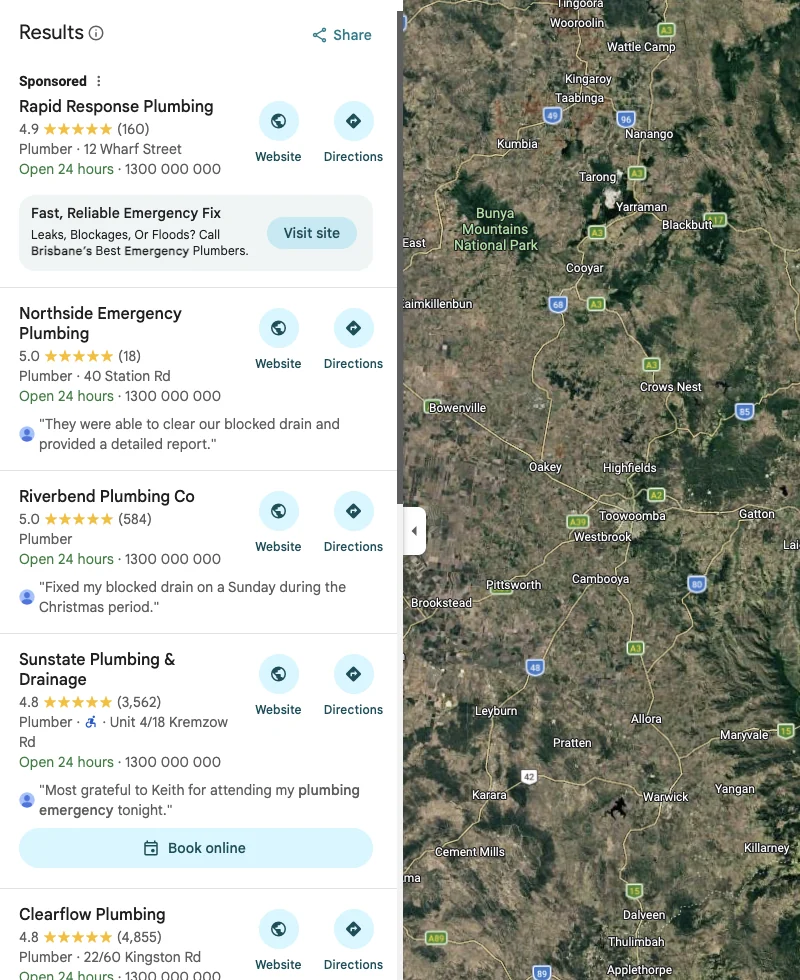
Four formats show inside Maps, and each one needs something different from your account. Google Ads Help lists them under “How to advertise in Google Maps.” Only the first two matter much for a home-services account.
| Format | Where it shows | What it needs |
|---|---|---|
| Map search ads | At the top of the Maps search results, with your business name, address and contact details | Location assets switched on in the account |
| Promoted pins | As a square pin on the map, instead of the usual round one | Your Google Business Profile linked to the Google Ads account |
| Map suggest ads | In the autocomplete list as someone types, in the Maps app only | A Performance Max, Smart or Search campaign |
| Placesheet ads | On a business detail page inside Maps | A Performance Max, Search, Display or Travel campaign |
One billing note. Google states that promoted pins are charged either by views or by clicks, depending on the campaign type. Everything else here is charged the way you are used to.
Can you pay to show only on Google Maps?
No. Google Ads Help says it plainly: currently, you can’t serve ads exclusively in Google Maps. The campaigns that can appear on Maps also serve on other surfaces, and Google decides the split. There is no box that says “Maps only.”
So if someone offers to run you a Google Maps campaign as its own line item, they are selling you a setting. Ask them which campaign it lives in. If the answer is vague, you have your answer about them.
What does advertising on Google Maps cost?
The same as your other clicks. Google charges a standard cost per click on local search ads. What counts as a click is wider than you might expect: a tap on your location details, a request for directions, a mobile call button tap, and a visit to your website all cost you money.
Read that list again, because it is where map spend leaks for a service business. You drive to the customer. They do not drive to you. Every “get directions” tap you pay for is someone planning a trip to your yard that nobody is making. It is a real charge against a job that will never exist.
The numbers you actually budget against are further up the funnel. Blended plumbing and HVAC leads ran $104 in January 2026. Roofing sits at a $228.15 median cost per lead. Ten leads at $104 is $1,040 out the door. Whether that is cheap depends on how many of the ten your team books and what those jobs are worth. Google’s own guidance here is useful: if you want calls for a local business, use location assets rather than call assets. The full pricing picture is in what Google Ads really cost a contractor.
How do you tell if Maps is doing anything for you?
You cannot pull a report that says “Maps.” Google does not break Maps out as its own line, which follows from the fact that you cannot serve there on its own. What you can do is measure the thing Maps is supposed to deliver, which is business from people close to you.
The distance report does that. Google describes it as reporting the distance between the location that triggered your ad and your closest business location, and it needs location assets to work. It runs on Search and Shopping campaigns. To find it, click Campaigns, then Insights and reports, then Report editor. Choose your campaign, then Predefined reports, then Locations, then Distance.
Read it with one question in mind. Are the leads coming from inside the ring your crew actually drives? If most of your spend sits out past that ring, you do not have a Maps problem, you have a targeting problem, and your location settings are where you fix it.
What does Google Ads not control in the map results?
The free pins. That is the honest answer, and it is the part most articles on this topic quietly skip. Google Ads buys you a placement next to the map results. It does not move you up inside them, it does not change your rating, and it does not put you on the map for free.
So if your unpaid listing is thin, an ad does not fix it. It rents you a spot beside it. That work sits outside Google Ads and outside this guide. What Google Ads does control is real, and it is enough: where you show, when you show, what the ad says, what a click costs, and which searches you refuse to pay for.
Be careful with anyone who blurs the two. “We’ll get you to the top of Maps” is a sentence that could mean an ad placement you can buy today, or something nobody can sell you. Make them say which. Being told plainly what a channel can and cannot do is a fair thing to expect from anyone you pay to run Google Ads.
Is Google Maps advertising worth it for a contractor?
For most contractors this is not a separate decision. Location assets are already the right call on a Search campaign, and Maps eligibility comes with them. So the answer is yes, switch it on, and no, do not treat it as a project.
Here is when it earns real attention. You take emergency work, so people search on a phone, near you, ready to call now. That is the searcher behind the 76% figure above. Your address is in a metro where a map placement puts you in front of the person before they scroll. Your phone gets answered when it rings.
Here is when it does not. Do not switch on Performance Max just to get map coverage, because you will buy a lot more than map coverage and you will see a lot less of where it went. Read why Performance Max usually burns a local budget before you go near that. And do not add map placements to an account that is already leaking. If leads are not turning into booked jobs, the fix is upstream. Start with the audit checklist, or why Google Ads is not working if results have gone flat.
Stop reading · start fixingSee where your pipeline is leaking.Free 15-minute Leak Finder. We pull up your numbers, name your biggest leak, and hand you a 90-day plan. No sales script, no hard close.Find My Google Ads LeaksFAQ
How much does it cost to advertise on Google Maps? There is no separate Maps price. You pay your normal cost per click, and location detail clicks, direction requests, call taps and website visits all count as clicks. For scale, blended plumbing and HVAC leads ran $104 in January 2026, and roofing sat at a $228.15 median cost per lead.
Can I run ads only on Google Maps? No. Google states you cannot currently serve ads exclusively in Google Maps. The campaign types that reach Maps also serve elsewhere, and Google splits the delivery. Anyone selling a standalone Maps campaign is selling you a setting inside a campaign you already have.
Why are my ads not showing on Google Maps? Usually location assets are not switched on, which is the requirement Google names for Map search ads. After that, check whether your location targeting even covers the area you are testing from, and whether the campaign is limited by budget. The not working guide runs the full diagnosis.
Do promoted pins make sense for a business that goes to the customer? Rarely as a goal on their own. Promoted pins are built around getting people to a location, and you drive to them. Map search ads with a phone number do more for you, because the win is a call, not a visit. Judge both on booked jobs, not on map impressions.
Do I need a website to advertise on Google Maps? Yes, for the campaign types that matter to you. A Search campaign needs a page to send clicks to, and your ad still has to earn the call once it shows. Location assets add your address and phone details on top of that. They do not replace the page.


