- What does high-performing home-services ad copy look like?
- How to write Google Ads copy that books jobs
- Ad copy examples by trade
- What are the most common ad copy mistakes contractors make?
- How to write headlines and descriptions that match search intent
- How responsive search ads change how you write copy
- How to test ad copy on a small account
- FAQ
What does high-performing home-services ad copy look like?
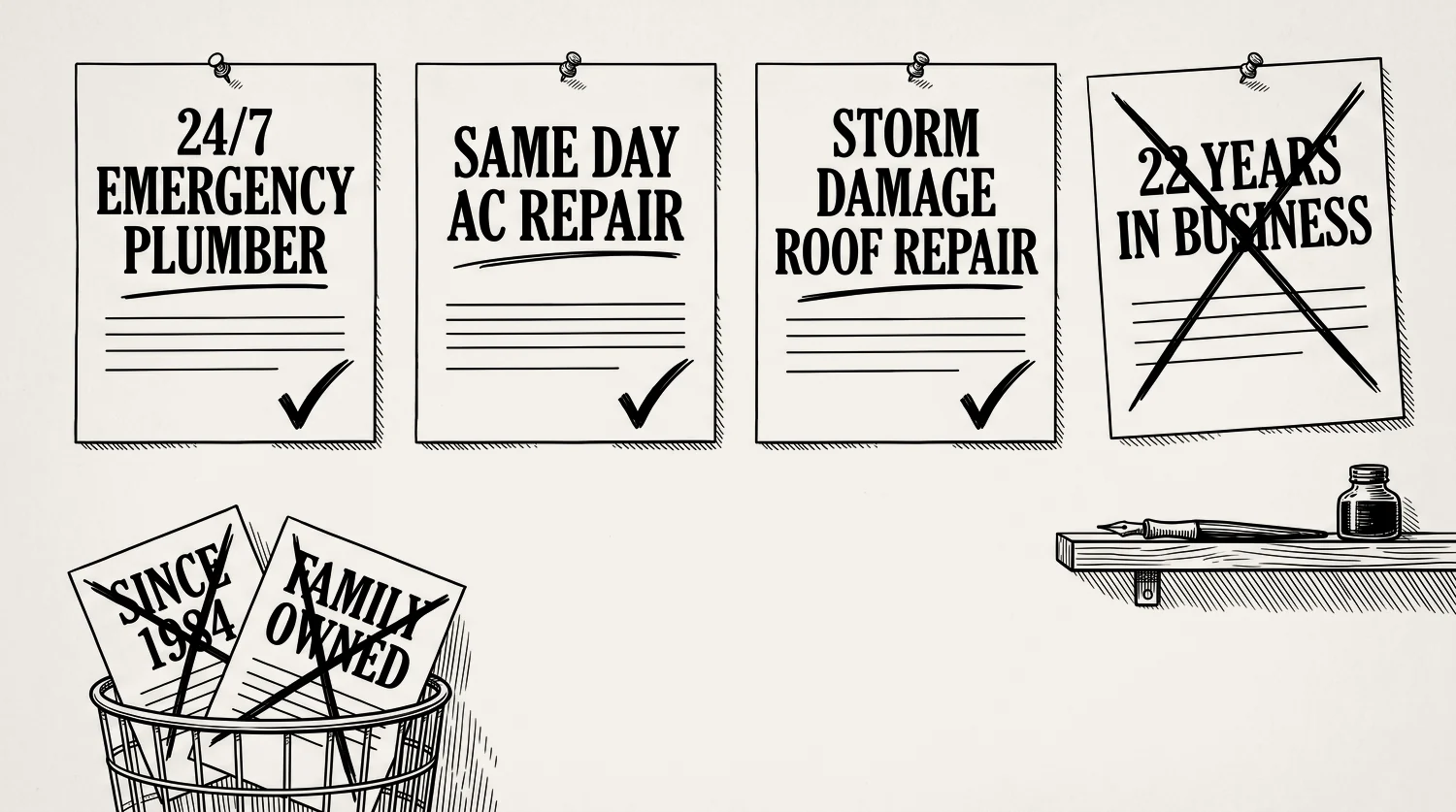
Strong home-services copy is specific, local, and honest. The headline names the exact service and area. The description names the problem, gives one real reason to trust you, and asks for the call. It reads like a local who answers the phone, not a brand writing a tagline.
Here is a real emergency plumbing ad, redacted:
Headlines: 24/7 emergency plumber | Burst pipe? we answer now | Licensed [suburb] plumber
Description: Blocked drain or burst pipe, we send a licensed local crew fast.
    Upfront price before we start. Call now.
Walk through why it works. The keyword sits in headline 1, so the searcher knows they are in the right place. The area and the urgency ride in headlines 2 and 3. The description names the two jobs people search at 11pm, then gives proof (licensed, local, upfront price) and a plain call to act.
Now the part a competitor cannot copy. Your suburb. Your real arrival time. Your licence number. Your reviews. A rival can steal your headline by lunch. They cannot steal the proof behind it. That is the whole edge of a home-services ad. The specifics are the moat. The brand-canon slogans you see in most roundups have none of that, because they were never built to book a job this afternoon.
One rule holds across every example on this page. No guarantees. Not “guaranteed same-day,” not “results guaranteed.” Guarantee language is the number-one tell of a churning agency, and it can breach ad policy. Even our own Pipeline Promise is a contract term, not an ad headline. Sell the specific, not the promise.
How to write Google Ads copy that books jobs
Write in a build order, not all at once. Lock the parts that must be there, add the trust parts where they fit, then reach for a differentiator or two. A disciplined ad beats one stuffed with every angle. Here is the order we use in real accounts.
- Headline 1: the service plus the area. Put the keyword in it. “Emergency plumber [city].” The searcher scanned four ads. Yours has to say “yes, this exact thing” first.
- Headlines 2 and 3: intent and trust. Match the urgency of the search (24/7, same-day, book online) and add proof (licensed, insured, 15 years, financing, free quote).
- Description: problem, solution, proof, ask. Name what broke, say you fix it, give one trust signal, and ask for the call or the quote. One idea per line.
- Assets: expand the footprint. Add call, location, sitelink, and callout assets so the ad takes more room and the phone number shows. Full guide in Google Ads assets.
- Continuity: the page must match the ad. If the ad says “blocked drains, [suburb],” the click lands on a blocked-drains page for that area, not the homepage. Break that promise and the click bounces.
Below is our ad-copy menu. It is the same discipline we apply to every responsive search ad. Lock the Defaults. Add Preferred where it fits the searcher. Use Optional levers to stand apart or to test.
| When to use | Element | What it does |
|---|---|---|
| Default | Keyword in headline | Confirms the searcher is in the right place. Usually headline 1 or 2. |
| Default | Intent and specificity | Match the ad to how ready they are to buy. Emergency copy for emergency searches. |
| Default | Call to action | Tell them the next step. Call now. Book online. Get a quote. |
| Default (local) | Proximity | Name the area. Add a local number call asset. |
| Default | Continuity | Whatever you claim in the ad, show it on the page you send them to. |
| Preferred | Features and benefits | Say what it is and what they get. “Camera drain check, so you see the crack too.” |
| Preferred | Single focus | One offer per ad group. Do not cram every service into one ad. |
| Preferred | Problem and solution | Name the pain, then the fix. Survey your last ten customers for the words they used. |
| Preferred | Pre-qualify | Weed out the wrong clicks. “Whole-home replacement” filters out the pane-repair searcher. |
| Preferred | Timely and punctuation | Use recency and a symbol (%, $, ?) to stand out, sparingly. |
| Optional | Show results | What do they really want? A dry basement. A hot house made cold again. |
| Optional | Social proof | Reviews, years, jobs done. Real numbers only. |
| Optional | Competitor contrast | Call out the cheap-and-gone crowd without naming anyone. “No surprise invoices.” |
Tie three of these straight to the click. The call to action, the proximity, and the continuity all have to survive from the ad to the page. If the ad promises an upfront price and the page hides it, the searcher feels the switch and leaves. Match the ad to the page and the page to the ask.
Ad copy examples by trade
Different trades sell to different searches, so the words change. Below is one redacted example per trade, with the one thing that makes it pull. Use your trade’s real vocabulary. A searcher who works in the trade, or has hired it before, hears a faker instantly. Your crew hears the right words on site every day, so ask them what customers actually say when they ring.
Headlines: Storm damage roof repair | We handle your insurance claim | Free roof inspection [city]
Description: Hail or wind damage? Local crew, we document the claim line by line.
    No pressure. Book a free inspection.
Why it works: it speaks to the insurance job, not just “roofing.” “We handle your claim” and “line by line” tell a homeowner you know Xactimate and supplements. That is the roofing buyer’s real worry.
Headlines: Same-day AC repair | Financing available | Licensed [city] HVAC
Description: No cool air? Same-day service most days. Flat-rate price up front.
    Ask about 0% financing. Book now.
Why it works: same-day plus flat-rate plus financing hits the three things a homeowner with a dead system cares about. Financing lifts close rates on big-ticket replacements.
Headlines: Blocked drain specialist | Camera drain inspection | Upfront pricing, [suburb]
Description: Slow or blocked drain? We find the cause with a drain camera,
    then quote before we start. Licensed local plumbers.
Why it works: “camera drain inspection” signals you diagnose, not just plunge. That is also the front door to bigger relining work.
Headlines: 24/7 water damage cleanup | We bill your insurer direct | On site in 60 min
Description: Flooded floor or burst pipe? Certified crew, fast dry-out to stop mould.
    We work directly with your insurance. Call now.
Why it works: speed and “we bill your insurer direct” answer the panic. Certified and mould-stop language shows you know mitigation, not just mopping. Writing to the panic like that is most of what a restoration account has to get right in the first hour.
Headlines: Replacement windows [city] | Free measure and quote | Finance options available
Description: Draughty, fogged or stuck windows? We measure, quote, and fit.
    Our own installers, not subcontractors. Book a free measure.
Why it works: a replacement job is not an emergency, so the ask is a free measure, not a call-out. “Our own installers” answers the thing homeowners worry about most on a big fit-out, and naming finance opens the door on a whole-house price. That slower ask is why a windows and doors account is run to booked quotes, not phone calls.
What are the most common ad copy mistakes contractors make?
The same handful of mistakes drain most contractor accounts. Each one either wastes clicks you paid for or buries the phone number.
- One ad for every service. “Plumbing services [city]” shown to the burst-pipe search and the tap-drip search. Both see the same vague ad. Split by service and write to each.
- No call to action. The ad describes you and forgets to ask. Every ad needs a next step: call, book, or get a quote.
- Guarantee claims. “Guaranteed lowest price,” “results guaranteed.” It reads like every churning agency and can trip ad policy. Sell the specific instead.
- Keyword stuffing. “Plumber plumbing plumber near me plumbing.” It reads like a robot and Ad Strength drops. Use the keyword once in a headline, then talk like a person.
- Ad and page do not match. The ad sells emergency service, the page is your about-us. The click bounces. Send each ad to the page about that job.
How to write headlines and descriptions that match search intent
Match the copy to how ready the searcher is to buy. A “burst pipe now” search and a “how much is a new roof” search want different ads, even in the same trade. Write to the intent, not just the keyword.
Think of three tiers. Research searches (“cost to reline a drain,” “how long does a roof last”) are early. The searcher is not ready to call. Copy here can offer a guide, a free inspection, or financing, and set up the follow-up. Ready-to-act searches (“emergency plumber open now,” “same-day AC repair”) are urgent. Copy here is short, local, and call-first. Skip the education. Give the number.
The lesson is simple. Do not send urgent copy to a researcher, or a researcher’s soft ad to someone whose pipe just burst. Sort your keywords by intent first, then write the ad to match. How to read and sort that intent lives in keyword research. Weak, off-intent copy also drags your Quality Score, which quietly raises what you pay per click. Knowing what one lead is worth paying for shows how much a weak, off-intent ad really costs.
How responsive search ads change how you write copy
Google’s default ad type is the responsive search ad. You do not write one finished ad. You give Google up to 15 headlines and 4 descriptions, and it mixes them per search. So every headline has to make sense in any order, next to any other. Write them as standalone parts, not as a sentence split across boxes.
That changes the craft. You are writing a set of true, self-contained claims, then letting the system test them. The full mechanics, pinning, and Ad Strength are covered in responsive search ads.
How to test ad copy on a small account
Be honest about your data first. Most contractor accounts do not get enough clicks to test headlines quickly. If a campaign books ten jobs a month, a headline test can take months to call a winner. So test big swings, not tiny wording tweaks, and give each one real time.
Here is what we do on a smaller account. Keep two or three strong responsive ads live per ad group and let Google rotate them. Test one meaningful thing at a time: the offer (free inspection versus flat-rate), the main angle (speed versus price versus trust), or the call to action. Use Google’s ad variations or an experiment so the test is clean. Then leave it alone. Do not judge an ad on a slow week. Judge it when enough booked jobs have come through to trust the pattern. Changing copy every few days just to feel busy resets the clock and teaches you nothing. Knowing when to leave an ad alone is a real part of running an account for booked jobs rather than activity.
Stop reading · start fixingSee where your pipeline is leaking.Free 15-minute Leak Finder. We pull up your numbers, name your biggest leak, and hand you a 90-day plan. No sales script, no hard close.Find My Google Ads LeaksFAQ
How many headlines should a responsive search ad have? Give it as many strong ones as you can, up to the 15 it allows, and at least 4 descriptions. More real, varied headlines give Google more combinations to test. Do not pad with junk to hit 15. A tight set of true, specific headlines beats a full box of filler.
What makes a good call to action for a contractor ad? A clear next step tied to how they want to reach you. “Call now” for urgent trades. “Book online” if you take online bookings. “Get a free quote” for big-ticket jobs. Keep it a single ask, and make the landing page offer the same action so the promise holds.
Can I mention price in my ad copy? Yes, and it often helps. “Upfront pricing,” “flat-rate,” “$0 call-out,” or “free inspection” pre-qualify the searcher and filter out price shoppers you do not want. Only state a price or offer you actually honour, and show the same offer on the page.
How do I improve my Ad Strength? Add more distinct headlines and descriptions, include the keyword in a headline or two, and avoid repeating the same phrase. Keep it in proportion, though. Google states that Ad Strength “isn’t used to calculate Ad Rank, Quality Score, or auction wins”.[1] It is feedback, not a grade that decides whether you win the auction. Aim for “Good” or better, then stop. Relevance to the searcher matters more than the label.


